

New Research Reveals Britain’s Hidden employment Crisis: Major White Paper report Due Q3
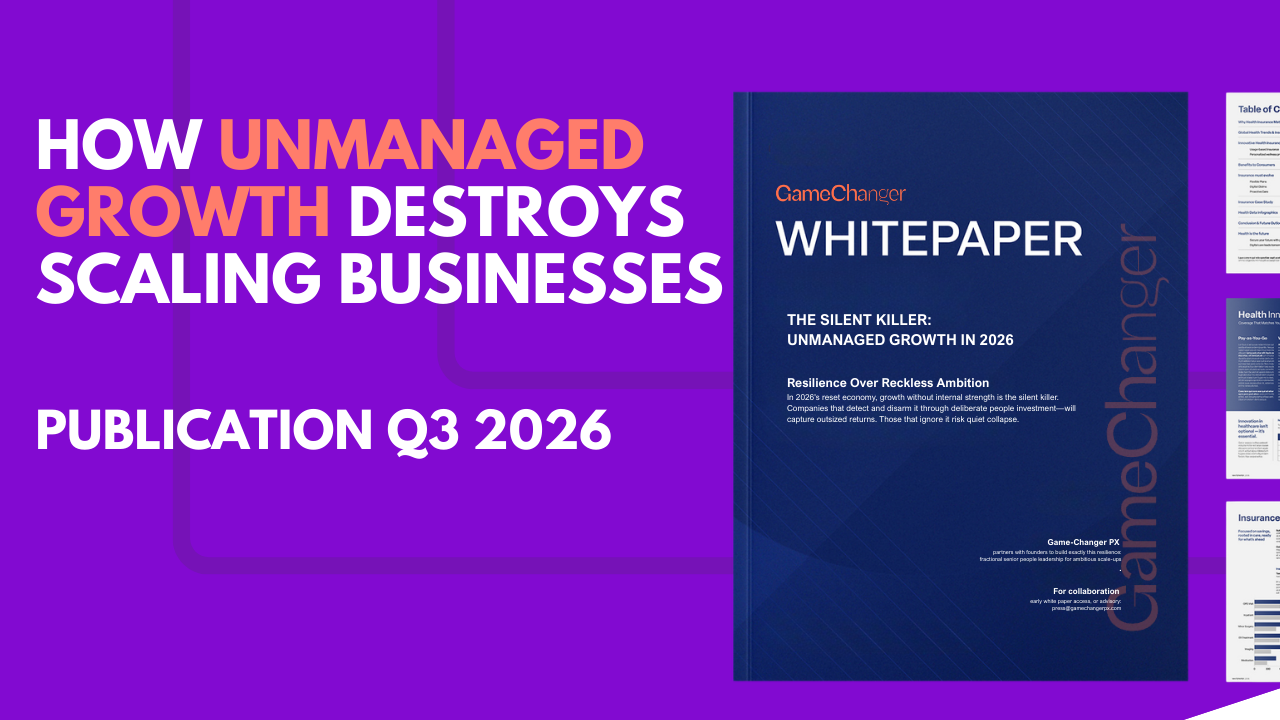
Game-Changer PX Warns Unmanaged Growth Is the Silent Killer of 2026
LONDON, UNITED KINGDOM, March 19, 2026 /EINPresswire.com/ -- Groundbreaking new research led by Darren Bates-Hirst, founder of Game-Changer PX, exposes a dangerous and largely invisible threat facing Britain’s high-growth companies: the internal collapse that occurs while businesses appear to be thriving on the outside.While headlines focus on rising unemployment, falling vacancies, and prolonged job cuts, Bates-Hirst’s in-depth analysis ,combining proprietary insights from dozens of scaling organisations (30–400+ employees) with the most current official statistics,concludes that the greatest danger in 2026 lies not in the companies announcing redundancies, but in those still aggressively hiring, still raising capital, and still publishing confident updates, yet quietly suffering from leadership overload, fragmented people systems, rushed promotions, inconsistent management capability, and creeping cultural erosion.
These internal fractures, the research finds, trigger silent attrition among top performers, erode decision-making speed and quality, stifle innovation, and inflate hidden costs long before they register in financial reports or investor updates. “The jobs disappearing right now are painful and real,” Bates-Hirst states. “But the far more expensive and harder-to-reverse damage is happening inside the businesses that look healthy from the outside, the ones still adding headcount, still chasing ambitious targets, but doing it with stretched managers, unclear progression paths, brittle processes, and teams that are quietly disengaging. That’s where the strongest talent starts walking away, not with fanfare, but one resignation at a time, and once that momentum builds, recovery becomes exponentially harder and more costly.”
The research highlights a convergence of external and internal pressures creating a perfect storm for scaling businesses:
UK unemployment has climbed to 5.2%, payrolled employment dropped by 109,000 year-on-year (November 2025–January 2026), and job vacancies stand at 721,000 - 69,000 below pre-pandemic levels (ONS). The ratio of unemployed people per vacancy has widened to 2.6 (from 1.9 a year ago), the loosest outside the pandemic since 2014–15; redundancy rates have risen to 4.5 per 1,000 employees; regular pay growth has slowed to 3.8%, its weakest level since late 2020 (ONS).
UK companies have now reduced headcount for 17 consecutive months, the longest continuous decline recorded by the PMI since the global financial crisis with February 2026 alone pointing to roughly 15,000 job losses (S&P Global PMI). 84% of employers report higher employment costs from National Insurance changes, with 32% describing the increase as “large”; hiring intentions remain at unprecedented lows outside pandemic periods (CIPD).
Business confidence has deteriorated sharply: only 46% of firms expect turnover to rise over the next 12 months (lowest in three years), 27% have cut investment plans, and 78% of CEOs have revised strategic investment downward, with 32% delaying projects and 9% cancelling them entirely (British Chambers of Commerce / EY UK CEO Survey). Equity funding into smaller UK businesses fell 2.5% to £10.8 billion in 2024, deal numbers dropped 15.1%, and business angel investment via EIS declined 20% to £1.6 billion — 31% below its 2021/22 peak (British Business Bank / Beauhurst H1 2025).
These tightening external conditions, higher costs, scarcer capital, slower growth expectations, leave far less room for internal dysfunction. Yet the research shows that many scaling companies are inadvertently amplifying risk by prioritising headcount growth over leadership bandwidth, cultural cohesion, and robust people infrastructure. Supporting evidence includes Gallup’s finding that managers account for 70% of the variance in team engagement, and SHRM estimates that replacing a single employee can cost 50–200% of their annual salary, with the figure rising steeply for senior or specialist roles.
When replacement costs collide with thinner margins and more demanding investors, the commercial impact of even modest talent leakage becomes severe.
“Culture doesn’t implode overnight,” Bates-Hirst explains. “It frays at the edges, inconsistent messaging, unclear accountability, delayed feedback, uneven promotion decisions. Over months, trust erodes, discretionary effort drops, and high performers quietly update their LinkedIn profiles. By the time turnover spikes or productivity stalls enough to alarm the board, the organisation has already absorbed massive hidden losses in lost knowledge, stalled projects, and recruitment spend.”
The full scope of these findings, including proprietary benchmarks, early-warning indicators boards should track today, quantified commercial costs of unmanaged scaling, and a proven framework for building resilient people systems in a low-margin environment, will be published in a comprehensive white paper by Game-Changer PX in Q3 2026.
About Darren Bates-Hirst
Darren Bates-Hirst is the founder of Game-Changer PX and a recognised expert in people strategy for high-growth companies. He advises founders and leadership teams scaling from 30 to 400+ employees and has supported businesses that have collectively raised over £200 million. His focus is on leadership alignment, organisational design, and the human foundations required for sustainable, profitable expansion.
About Game-Changer PX
Game-Changer PX provides fractional HR leadership and people-performance advisory to fast-scaling businesses that require senior-level people expertise without the overhead or inflexibility of a full-time HR director. The firm helps leadership teams align people systems with aggressive growth goals — preventing internal strain from becoming expensive talent loss and commercial setbacks.
Adam Vaughan
The Times
+44 7872 587747
email us here
Legal Disclaimer:
EIN Presswire provides this news content "as is" without warranty of any kind. We do not accept any responsibility or liability for the accuracy, content, images, videos, licenses, completeness, legality, or reliability of the information contained in this article. If you have any complaints or copyright issues related to this article, kindly contact the author above.
